

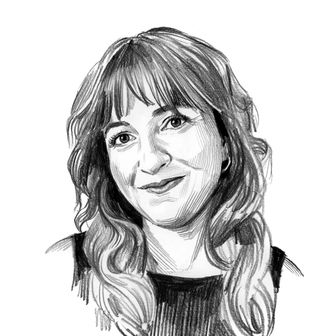

At a moment when it feels like fashion has become as obsessed with thinness as it’s been since the early 2000s, Mac Rose has some different ideas. The stylist, who splits her time between Brooklyn and Copenhagen, has amassed a following on TikTok with videos showcasing her unique perspective on styling. Instead of slim silhouettes and cinched waists, Rose endorses getting dressed in a way that takes up space — a billowing dress over wide-legged pants, or an oversize blazer with a bubble skirt — “You look better bigger,” she said in a 2023 TikTok, a concept that’s become key to her philosophy and one that feels borderline radical in the age of Ozempic. We spoke to Rose about her style theory and how you can try it on for size.
Tell me a bit about your styling philosophy.
I would say it’s about attacking fashion from a place of indulgence instead of restriction. I think a lot of the time people interact with clothing starting from a place of what they cannot do, but we always want to come at it from a place of creative fulfillment and excitement. And what that means is when we notice space is missing, we add things instead of restricting and taking away. If we notice that visual harmony is missing from our bodies, instead of trying to take away our size or take away our presence and slim the visuals of our body down, we want to add to our presence wherever we feel like something is missing and enlarge ourselves instead of trying to shrink.
You have a bit of a mantra you talk about on TikTok: the idea that people “look better bigger.” What do you mean by that?
When I say you look better bigger, I just mean your presence is stronger. It’s about feeling like you’re walking into a room and your whole presence is there and you’re comfortable with being seen.
In terms of clothing, I would say that means structured pieces that can stand on their own and not wait for the body to tell them how to look — so not things that are super skintight, not things that are elastic or spandex, maybe a super-nice tailored blazer that’s made of suede, something that’s really heavy and can kind of sit on its own. One of my favorite outfit formulas right now is a boxy suede blazer and a long maxi skirt, because those are two very big, elongated pieces. Same with barrel-leg trousers.
Do you have any beginner-level tips for people who are curious to try out dressing “bigger”?
Make sure your joints are exposed. People always think, Oh, I could never wear that because I put on oversize clothes and it looks so baggy — it’s most likely because the clothes are uncuffed and going well beyond your wrists or ankles. Same with the clavicle — if you want to wear a plunging neckline and pair it with a giant bubble skirt, that’s going to give you a little bit of positive visual space.
Another technical styling tip is the hair — hair is a very large piece of visual weight, especially if we leave it down. So if you’re wearing something that’s baggy or oversize, pull your hair back or up so that visual weight is a little bit higher.
Also, shoes have a massive effect on the wardrobe. When wearing a wide leg, a tall boot underneath will act as a structural beam for the fabric, stiffening the leg and solidifying the silhouette.
Any other ideas for simple outfit formulas?
One classic silhouette to try is pairing an oversize button-down with oversize trousers, but I like to add a little twist with a loose necktie.
If you want to experiment with some layering, try out a pair of barrel-leg jeans layered under a miniskirt, pair it with a cardigan buttoned once or twice in the middle, and finish it off with a coat. The cardigan buttoned at the center will give the appearance of a vest, providing some dynamic shapes amid the fluidity.
You’ve spoken about how your experience fluctuating in size has shaped your perspective on style — can you tell me more about that?
I was about a size 18 or 20 for most of my life, and it wasn’t until I got diagnosed with chronic illness in 2021 that I lost weight involuntarily. My body had served me very well up until that point, so when I lost weight, I had a very negative connotation of losing that visual weight on my body. I had a negative perspective of going down these sizes because I lost a sense of community, I lost a sense of belonging, and I lost a huge part of my message, which was about body neutrality and comfortability.
When I was living in a bigger body, I had this kind of feeling of like, Well, I’m not even in the game, so I can do whatever I want — dressing “flattering” was never really a factor in my personal style, because I believed I was never even in the running to achieve it.
Looking back now, I feel lucky to have gone through that because I can attack styling all different types of bodies from a personal perspective of having lived in a wide range of them.
Let’s talk about that word, “flattering.” What does it bring up for you?
Oftentimes, people have a negative connotation with that word because it’s a beautiful cover-up word for thin: People conflate “flattering” with how to look as small as possible. Whether that means dressing for your body type, dressing in all black, or dressing in slimming fabrics. The way to achieve this word, which subconsciously means “beautiful,” is through restriction, through taking away, through thinning.
As a stylist, it’s very important for me to use neutral language when I’m working with clients, so instead of saying the word “flattering,” I often opt for the word “harmonious.” The difference is not How can I make your body look as small as possible, it’s more How can we make you feel even and harmonious in your frame?
What effect do you think this can have on personal style?
Dressing “flattering” really has nothing to do with personal style — it really has a lot more to do with beauty standards, and if your only opinions on fashion are about the way clothes make your body look, then that’s not a fashion opinion — that’s a beauty-standard opinion. I think when we approach fashion from this place of creative fulfillment instead of trying to look as thin as possible, we can only strengthen our taste because we’re removing the crutch of beauty standard that so many build their opinions off of in the first place.
Something you’ve also spoken about is how being queer has informed your work as a stylist. What impact has your queerness had on your outlook on style?
I think maybe subconsciously that was also where the “I’m not even in the running” ideology came from, because from the age of 8 or so, although I wasn’t able to pinpoint my queer identity that young, I didn’t have this feeling of needing to impress anyone — it altered me in the sense that I felt like I could kind of do whatever I wanted.
I think with queer people and clothing in general, we have such a unique perspective to it because it’s such a tool, and beauty standard is only something that some of us are afforded to even worry about. Coming at style from the queer perspective, a lot of us use it to just get by in the beginning, just pass. The emotional part of it is also really hard — I think for a lot of queer people, we do have a very deep emotional attachment to clothes, whether that’s an identity that we’re mourning or an identity that we’re coming into.
For a lot of people, the idea of dressing your body in a way that’s not conventionally “flattering” can feel scary — what would you say to someone who thinks they can’t pull it off?
I would start by saying it’s not your fault for not wanting to step away from that — I understand why this idea feels a little off-putting from the start and why it’s so much easier to want to just fix yourself by making yourself shrink.
But why not add this way to your rotation of getting dressed? Try it out one day a week. It doesn’t have to be a way that you reshape your entire wardrobe, but take a baby step the next time that you get dressed and you’ve got nowhere to be — just try getting dressed in a way that amplifies your presence instead of shrinks it, and see if you notice when you’re looking in the mirror if your body feels more relaxed, if you feel more comfortable moving through the day.